
Erskine rises to meet growing needs in health sciences
Across the United States, communities face a need for more well-trained healthcare professionals, with South Carolina ranking especially low in physician availability, according to the Cicero Institute. A study published by the Association of Medical Colleges found that the nation will likely “face a physician shortage of 86,000 by 2036.”
As the need for well-prepared medical professionals increases, Erskine is expanding and elevating its School of Mathematics and Science to equip students in pre-professional programs, health science, biology, and chemistry and prepare them to make a positive impact on our state and beyond.
Erskine’s newly restructured School of Mathematics and Science is led by Dr. Jessica Minor, whose prior experience as a dean in the health sciences has prepared her to lead Erskine’s science programs into the future. Other recent faculty appointments bring exceptional experience, which will support rigorous instruction and personal mentoring for students.
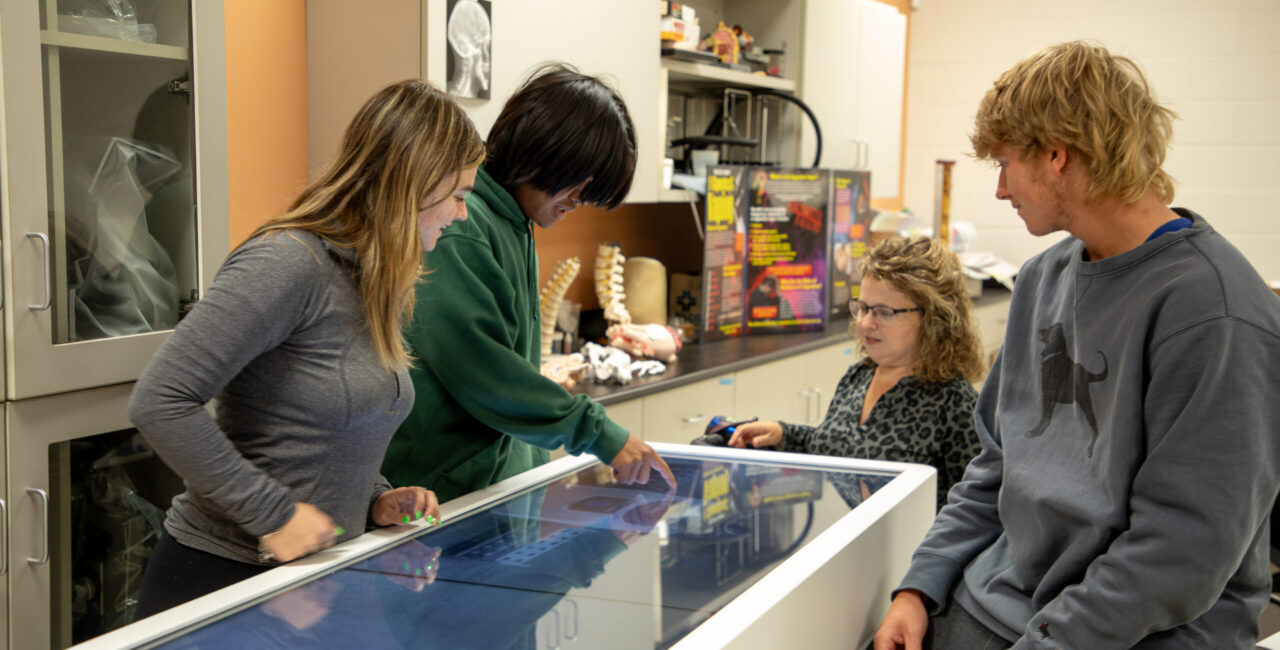
Recently, thanks to generous donors, Erskine purchased an Anatomage Table, an interactive tool that allows students to study anatomy in three dimensions using digital cadaver models. Erskine joins an elite group of institutions in the area to own this powerful tool and is one of the few to give undergraduates access to the technology.
“The Anatomage Table will provide students with an interactive, hands-on approach to studying human and animal anatomy,” Minor says. “My hope is that this technology will strengthen students’ understanding of anatomy, encourage curiosity, and help them connect foundational scientific knowledge with real-world applications.”
Erskine is also exploring new program options to prepare students for the medical field. This fall, the Board of Trustees authorized the pursuit of a nursing program. Erskine President Dr. Steve Adamson and members of the institution’s academic leadership have held an initial meeting with the South Carolina Board of Nursing as part of that process. The proposed program remains subject to required approvals.
Minor is excited by the possibility of developing a nursing program at Erskine and sees it as “a natural extension of our existing science and health-related programs.” Such a program “reflects Erskine’s commitment to preparing graduates for lives of service, leadership, and influence,” she says.
A nursing program would also give Erskine graduates a unique opportunity to benefit their community.
“South Carolina continues to face significant nursing workforce challenges, with some estimates projecting a nursing shortage of approximately 21 percent,” Minor says. “Although that shortage is expected to decrease over time, the need for well-prepared nurses will remain significant. A nursing program at Erskine would allow us to contribute directly to addressing this need, particularly in the communities surrounding the college.”
A significant resource for the work taking place at Erskine is the $3 million Erskine Forward grant, recently awarded through the U.S. Department of Education’s Strengthening Institutions Program. This five-year award supports several academic and student-success initiatives, including laboratory renovations, healthcare training facilities, simulation technology, and instructional equipment.
Erskine Provost Dr. Edward Clavell has helped guide these efforts, drawing on his experience in academic leadership and program development.
“The Erskine Forward grant will help us give students the hands-on learning experiences they need to prepare for careers in healthcare and education,” Clavell says. “These investments advance Erskine’s mission by equipping students to serve their communities with professional excellence, compassion, and a strong foundation of Christian faith.”
As Erskine enhances the student experience, students will be prepared to make meaningful contributions to the health professions and other areas of scientific innovation.
“These investments reflect Erskine’s continuing growth as a Christian liberal arts university, bringing together a broad foundation in the liberal arts and expanding opportunities for professional study,” Adamson says. “We are building on a tradition of preparing graduates to serve with knowledge, skill, and a Christian understanding of the dignity of every person they encounter.”
(Pictured: Students and Dr. Minor utilizing Erskine’s Anatomage Table)
