
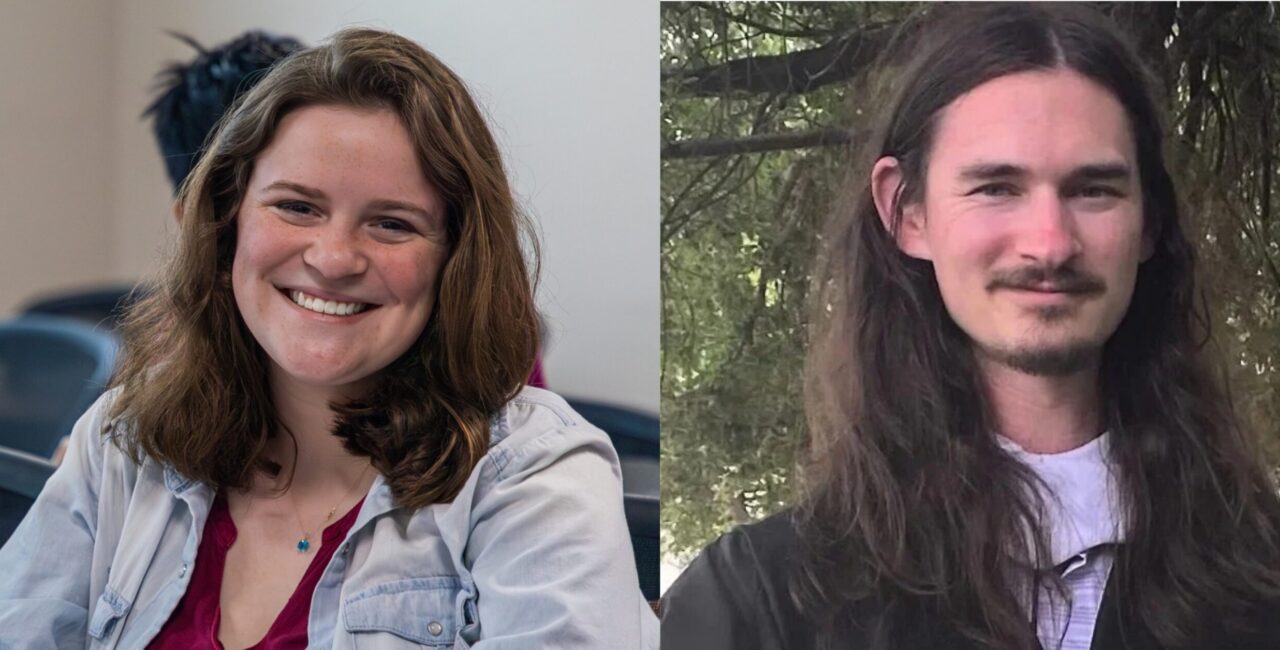
History grads pursue Ph.D.s at Rice, Clemson
Two recent Erskine graduates, Sharon George Dorsey and David Wilkie, both Class of 2024, are pursuing Ph.D.s and making a mark in historical research. Their current work builds on the strong foundation and faculty support they received as undergraduates.
While at Erskine, both Dorsey and Wilkie maintained an ambitious course of study—Dorsey as a triple major in History, Psychology, and Bible and Religion and Wilkie as a double major in History and Bible and Religion. Dorsey also met her husband, Josh Dorsey ’25, at Erskine.
Now, Dorsey is enrolled in Clemson University’s five-year digital history program, the first degree of its kind in the nation. Wilkie earned his master’s degree in history at Baylor University and is pursuing a Ph.D. at Houston’s Rice University.
Though the two are on different paths to their degrees, their respective research remains firmly grounded in the region they call home: the South.
Dorsey grew up in Spartanburg, a city whose history is interwoven with the textile industry. Her research focuses on the intersection of labor and religion in early-20th-century textile mill communities in the South. Within that niche, she focuses on the churches that served those communities.
“I don’t feel like textile mills, in particular, get the historical attention they deserve,” she says.
At Erskine, Dorsey studied child labor for her Junior Seminar class while growing her knowledge of mill villages and mill village churches.
A 1934 strike in nearby Honea Path led to the deaths of a half dozen strikers. The incident—dubbed the Chiquola Mill Massacre—received nationwide attention at the time. This event piqued Dorsey’s interest as it underscored the often-complicated relationship between mills, mill workers, and the supporting towns and churches—many of which were subsidized by the mill owners.
Both Dorsey and Wilkie reference their Junior Seminar and Senior Seminar classes at Erskine as pivotal in their development as history students.
“Junior Seminar is a class on historical research methods,” says Dr. John Harris, McDonald-Boswell Associate Professor of History at Erskine. “Students call it ‘Boot Camp’ because it’s tough!”
Senior Seminar, Harris says, “involves a deeper research project, with a longer paper and presentation. Both students will have found those classes useful for what they are doing now; it’s sort of a bridge between undergrad and grad school.”
Harris was impressed by Dorsey’s seemingly insatiable interests in history as an undergraduate.
“The history faculty couldn’t help but feed her curiosity. We kept coming up with ideas…Sharon kept rising to the challenge. We are so proud of her accomplishments,” Harris says.
Dorsey, in turn, is grateful for the one-on-one attention that she received at a small college like Erskine.
“I wouldn’t be where I am without the guidance I got from my professors. The history department always pushed me and supported me,” Dorsey says. “Dr. Harris and I talked before I applied to the Ph.D. program so I was better prepared for the challenges I would face, and Dr. Abu Sarah read my writing sample so I would be as competitive a candidate as possible. I’m incredibly grateful that they invested in me.”
Wilkie is from Clinton, South Carolina, and plans to pursue a career in higher education, ideally as a history professor at a small liberal arts college.
Erskine was on his radar early as an undergraduate option because of his family legacy there, dating back to his grandmother, Gwen Cook Hitt ’65, and including his mother, Lynn Cook Wilkie ’91.
“I was following in their footsteps, but I really saw in Erskine a place where I could get a good, intimate educational experience, as opposed to some bigger place, where I’d kind of get lost in the crowd,” Wilkie says.
For him, Erskine was the perfect bridge between the small town in which he grew up and the larger schools where he later studied. Originally, he had plans to focus on Bible and Religion and possibly attend seminary after college, but his interest shifted late in his undergraduate career.
“I really started to take history more seriously and thought this could be an actual career goal,” Wilkie says. “I still wanted to find a way to continue to study religion, but through a historical lens, which is what I do now. I’m really pleased with how it’s come together.”
Through conversations with Harris, Wilkie’s focus became clearer as he approached graduation.
“I am interested in Southern history, and I decided that it would be a good idea to pursue some kind of topic related to the institution of slavery in the South,” Wilkie says.
His current research at Rice focuses on enslaved women’s religious experiences and the ways in which those experiences shaped their lives and communities.
Harris describes Wilkie as “methodical, rigorous, and very comfortable working independently—all key features of a historian.”
“He’s also one of the finest writers I’ve encountered at Erskine,” Harris adds.
For Ph.D. candidates, the first year at Rice is primarily research and coursework, with teaching assistantships beginning in students’ second year. Wilkie quickly saw the benefit of his undergraduate training in Due West.
“Having come from Erskine as compared to some other people that came from larger institutions, they might have been a little less prepared than I was,” Wilkie says. “I fully attribute that to the experiences I had at Erskine.”
Wilkie likes Texas but plans to return to the East to teach after graduating from Rice.
“I would enjoy coming back East teaching at a small school. I want to give other students the wonderful educational experience that I had at a small school,” Wilkie says.
