
New academic structure designed to help Erskine students, faculty flourish
During the 2025-26 school year, Erskine has begun piloting a new academic structure which creates five distinct “schools” within the college: the School of Education, the School of Business, the School of Mathematics and Science, the School of Humanities and Social Sciences, and Erskine Theological Seminary and School of Biblical Studies. The new structure, expected to yield numerous benefits for faculty and students, is set to be implemented this fall.
Erskine Provost Dr. Edward Clavell says the five-school approach, which aligns with current best practices in higher education, will create “a clear center of gravity, a stronger voice” for each academic area and encourage “efficiency and agility.”
The new model will also strengthen Erskine’s position in the higher education landscape, says Erskine President Dr. Steve Adamson.
“The college will be positioned to better adapt to changes in the academic marketplace, add programs, bring increased enrollment and fundraising attention, and promote the academic excellence of the faculty,” the president says.
Ultimately, the change is about “building stronger academic homes where students and faculty can flourish,” Clavell says.
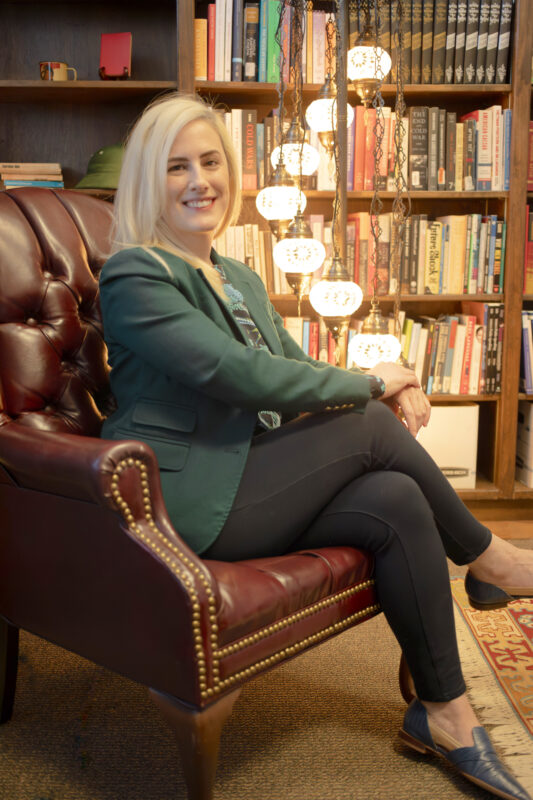
The School Restructuring and Growth Committee, responsible for orchestrating the structural transition, consulted with the Faculty Executive Committee, department chairs, faculty, and administration.
“Each group plays an important role on campus, and each group has experience and expertise that must be considered when shaping institutional change,” says Assistant Professor of History Dr. Christiane-Marie Abu Sarah, who chaired the committee. “We’ve drawn on a biblical vision of community as seen in Romans 12 and 1 Corinthians 12, which remind us that we are one body with many parts.…This has been our guiding philosophy as a committee.”
Clavell says reorganization offers four main benefits: leadership development, strategic growth, external partnerships, and enhanced recruitment and identity.
“This is a strategic shift designed to streamline academic administration, strengthen collaboration, highlight distinctive strengths, and position Erskine for long-term growth—while remaining faithful to our Christ-centered mission and ethos,” the provost says.
Faculty leadership development
The new structural model unifies related disciplines under the umbrella of a school. Each discipline (such as English, biology, or psychology) will continue to have its own chair, but that chair will report directly to the dean of the school, who will report to the provost.
“Using this model will enhance each area’s focus on academics, enrollment, and fundraising,” Adamson says.
Abu Sarah notes that school deans will “lighten the administrative load” for faculty and “improve operational efficiency.” She adds, “On a deeper level, by streamlining daily tasks, we want to give faculty the freedom to channel their energies effectively and pursue their passions.”
The reporting structure will also provide opportunities for faculty leadership training and career advancement, improving faculty retention.
“Faculty’s core commitment to teaching will remain the same,” Abu Sarah says. “Where the restructure will make a difference is by supporting faculty balance, clarity, and focus as they complete administrative work.…Our goal is to create the conditions for faculty to truly flourish.”
Strategic growth
While Erskine remains intentionally small, restructuring opens the door for growth in program development, enabling Erskine “to move quickly when opportunity knocks,” Clavell says. New programs “can be evaluated, piloted, and launched within a single academic ‘home’ rather  than built piecemeal across multiple departments.”
The School of Business, for example, could pilot innovative programs in response to current marketplace needs. Similarly, the School of Education could explore graduate programs and alternative pathways to teaching, in addition to its traditional undergraduate programs.
With the internal structure of the schools in place, academic areas will be equipped to respond more nimbly to program needs.
External partnerships
The new structure creates clear lines of communication between the college and external partners, such as healthcare systems, school districts, and businesses. This will benefit students as they seek opportunities for graduate studies, internships, or employment, and will bolster the college’s fundraising efforts through grant opportunities.
Within the School of Mathematics and Science, for example, Clavell sees fresh opportunities to build relationships with the medical community, which will “deepen health-profession advising, expand research and clinical shadowing partnerships, and secure articulation agreements,” creating new pathways to graduate school and careers in healthcare.
“Schools serve as natural counterparts for grants, internships, and workforce pipelines,” he says.
Recruitment and identity
While all students are first and foremost members of the Erskine family, the new model is designed to foster a sense of identity and ownership within each school.
“For students, this will mean clearer administrative processes, focused faculty support, creative innovation in programs, and a stronger sense of academic community within their chosen fields,” Abu Sarah says.
The schools will also create clarity for prospective students.
“A degree from a recognized School resonates in college searches and on resumés, enhancing Erskine’s competitiveness,” Clavell says.
Abu Sarah anticipates that each dean will be able to advance his or her school’s brand identity, which “gives each academic division a dedicated voice in strategic planning.”
“Ultimately,” Clavell says, “the school-based model enhances Erskine’s sustainability and reputation while keeping our focus on forming whole persons for service and leadership.”
All about community
In the end, the goal of the restructuring process is to enhance the Erskine community by supporting faculty and serving students.
Abu Sarah has observed a spirit of collaboration throughout the process.
“While restructuring at other institutions can stir up bitter rivalries,” the professor says, “at Erskine I’ve seen the restructuring process emerge as an encouraging example of the great things that can be accomplished when we work together.…I am grateful for all who have used their unique gifts in service to the college.”
Clavell is quick to emphasize that the new model supports Erskine’s identity and mission as a Christian school where students are challenged to grow and serve.
“This initiative strengthens—but does not change—the soul of Erskine,” the provost says. “Our Christian mission, commitment to whole-person education, and close-knit community remain at the center.”
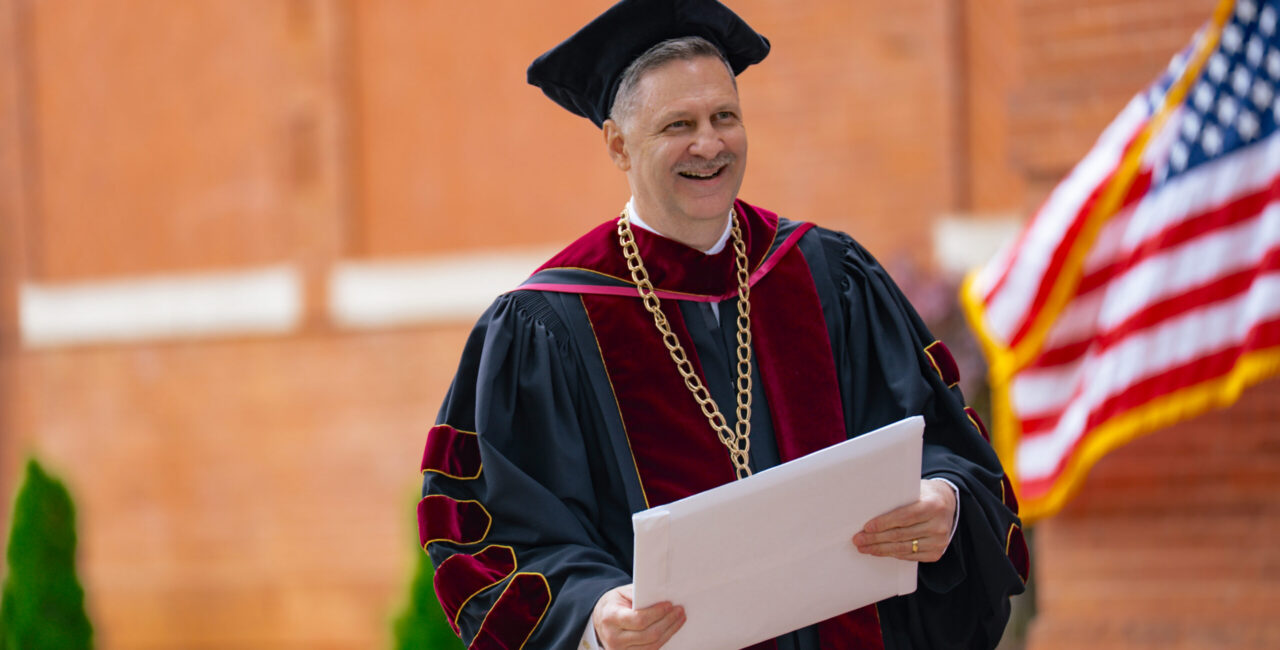
Pictured at top: Erskine President Dr. Steve Adamson at Commencement 2025
